


Stalking and harassment: what HR should be thinking about now
Stalking and harassment: what HR should be thinking about now
New Zealand now has a standalone criminal offence for stalking and harassment. The Crimes Legislation (Stalking and Harassment) Amendment Act 2025 received Royal assent on 26 November 2025 and comes into force on 26 May 2026.
For HR, this is more than a criminal law update. It is a prompt to check whether workplace policies, safety planning, privacy settings, and manager training are fit for purpose.
The new offence is based on a pattern of behaviour. That means specified behaviour occurring at least twice within a two-year period, where the person knows it is likely to cause fear or distress. In a workplace context, that might include repeated unwanted contact, following, monitoring, loitering near work, sending unwanted gifts, online contact, reputation damage, doxing, or using workplace information to track when and where someone is working.
Employers are not expected to investigate stalking in the way Police would. However, if the behaviour creates a work-related risk, the employer needs to respond. That may include risks involving customers, clients, contractors, former employees, current employees, or someone connected to a worker’s personal life.
Here are the key areas HR should review over the next few months…

Stalking and harassment: what the new law means for workplaces
Stalking and harassment: what the new law means for workplaces
New Zealand now has a standalone criminal offence for stalking and harassment. The change came into force on 26 May 2026 and gives clearer recognition to repeated behaviour that can cause fear, distress, or a real sense of being unsafe.
For workplaces, this is worth paying attention to.
Stalking is not always something that happens “outside work”. In some cases, the workplace is where the behaviour starts. It might involve a customer repeatedly asking for a particular staff member, someone waiting near the workplace, persistent messages through social media, unwanted gifts, or a person using work information to track when and where someone is working.
It can also happen within an organisation, including between current or former colleagues. Where there are power dynamics, close working relationships, or concerns about not being believed, affected workers may be reluctant to speak up early.
Smarter processes, stronger teams, better customer experiences
Across New Zealand, many businesses are being asked to do more with the same people, systems, and hours in the day.
Costs are tight. Customers expect quick answers. Teams are busy. Behind the scenes, small process issues often slow everything down: double-handling, spreadsheet workarounds, missed follow-ups, manual reporting, disconnected systems, and too much information sitting in people’s heads.
That is usually where the real opportunity starts.
At EASI NZ, we help businesses take a practical look at how work actually gets done. From there, we identify where better processes, automation, data, or AI-assisted workflows could make operations easier for the team and better for the customer.
This is not about replacing people with technology. It is about removing repetitive work and process friction so people can focus on the moments where they have the biggest impact on the customer experience.
Cost optimisation is not just about cutting.

Pay Rises and the Cost of Living: How Employers Can Respond Well
Pay Rises and the Cost of Living: How Employers Can Respond Well
It’s no surprise that the cost of living is putting real pressure on people right now. Fuel prices are front and centre, but they are far from the only issue. Rent, interest rates, utilities, insurance, and compulsory KiwiSaver contributions have all gone up too. For many employees, it can feel like their pay just is not stretching as far as it used to.
When that happens, it is natural for people to look to their employer for help, often in the form of a pay rise.
The challenge is that employers are often feeling the same squeeze. Many businesses are dealing with rising costs across the board, which means there is less room to move than staff might expect. So how do you respond in a way that is fair, practical, and still supportive?

Employee vs Contractor: What’s the Difference for New Zealand Businesses?
Employee vs Contractor: What’s the Difference for New Zealand Businesses?
As businesses grow, one of the most important decisions you’ll make is how to engage people to get the work done. Should you hire an employee or engage a contractor? Both options can work well depending on your business needs, but understanding the difference is essential.
In New Zealand, the distinction matters because employees and contractors have different rights, responsibilities, and legal protections. Getting the classification wrong can lead to compliance issues and unexpected costs.
At EASI NZ, we help businesses understand these differences so they can scale confidently and stay compliant.

HR for Small Businesses in NZ: A Practical Guide to Getting It Right
Most small businesses don’t start with an HR strategy.
They start with a skill, a trade, a service, or a gap in the market. The people side of the business often develops later — usually when the workload grows beyond what one person can manage.
For many owner-led businesses, HR evolves organically. A contract is downloaded when needed. A policy gets written after an issue arises. A conversation is handled as best as possible.
And often, that works — for a while.

Changing Employment Conditions & Managing Risk: What Employers Need to Know
Changing Employment Conditions & Managing Risk: What Employers Need to Know
One of the most common situations where employers run into employment claims is when they make changes to an employee’s conditions of employment — or take actions that could eventually put that employment at risk.
These situations often start with legitimate business needs. A business may need to adjust working hours, restructure roles, or address performance concerns. However, if the correct process is not followed, what begins as a practical management decision can quickly become a legal issue.
Understanding how to manage these situations properly is an essential part of being an employer.
Employers, Beware the “Accidental Employee”
Employers, Beware the “Accidental Employee”
For small business owners and managers, deciding when to employ, who to employ, and on what type of contract is one of the most important strategic decisions you will make.
It’s also one of the most common areas where we see well-intentioned employers inadvertently increase their risk — often without realising it.
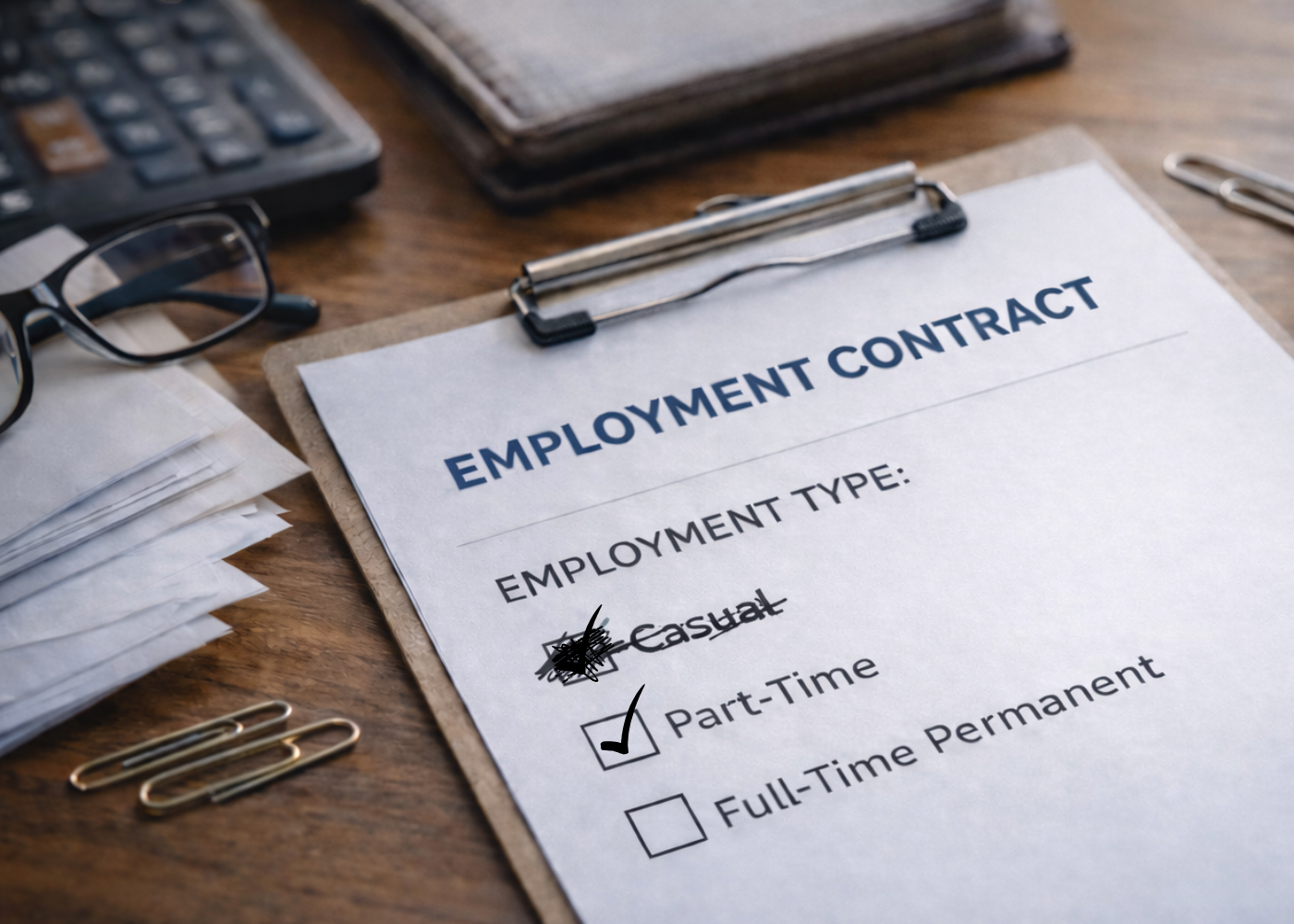
One of the biggest traps? The “accidental employee.”

Getting Prepared for 2026
Getting Prepared for 2026
Why HR Strategy Matters More Than Ever
For HR to truly support your business, it can’t operate as a purely administrative tick-box exercise. It should be a strategic function—one that directly connects your people, your processes, and your paperwork to your business goals, vision, and values.

Staff Christmas Party - company policies
Taking your staff out for a good time should seem like a simple enough task, but a staff party is still “work”, and your obligations don’t magically disappear just because you’re not on an actual work site.

HR Christmas Checklist
The festive season is fast approaching, and whether your business is gearing up for its busiest time of year or preparing to close for a well-earned break, planning ahead is key. A little organisation now will help you avoid last-minute stress, support your people, and ensure smooth operations heading into the New Year.
Here’s a practical HR Christmas Checklist to help you finish the year strong.

Pay Secrecy Changes: What NZ Employers Need to Know
Last month, Parliament passed the Employment Relations (Employee Remuneration Disclosure) Amendment Act, introducing new rules around pay transparency.
In simple terms, employers can no longer take disciplinary action against an employee for discussing their pay or asking about someone else’s. This applies even if the Employment Agreement contains a pay secrecy clause.
This brings New Zealand in line with countries such as Australia and is aimed at reducing unfair pay gaps — particularly those affecting women, Māori, Pasifika, and other groups at higher risk of pay inequities.

“Keeping Winter Ills and Chills Out of the Workplace ”
Winter bugs can hit small teams hard. This article explores practical, evidence-based ways to reduce the spread of illness in your workplace—saving time, money, and stress. From flexible sick leave to better ventilation and hygiene, learn how to keep your team healthy and your business running smoothly this winter.

“HR Vs HealTh & SAfety: Time to Share a Lunch Table!”
HR and Health & Safety teams often operate in silos—but under New Zealand’s HSWA, they’re on the same team. This article explores how collaboration between HR and H&S can improve mental wellbeing, onboarding, performance management, and ultimately, workplace culture and safety. It’s time to stop sitting at separate lunch tables.

“Job Sizing – How to Calculate Equitable Pay ”
This article explains how SMEs in New Zealand can use job sizing to ensure fair and equitable pay, especially for complex hybrid roles. It outlines the process of evaluating role responsibilities and skills to establish consistent, fair pay structures that promote transparency, improve retention, and support compliance with pay equity laws.

“Fair Pay Is Good Business”
In light of New Zealand’s updated Equal Pay legislation, leading with fairness and transparency in pay is more important than ever. Proactive leadership, regular pay audits, and open conversations foster trust, attract talent, and align your organization with legal and ethical standards for pay equity.

“Employment: When the Relationship Goes Down the Gurgler”
If an employee raises a Personal Grievance, you as the employer must be given the opportunity to understand the grievance and address it.
If informal discussions and mediation through the Ministry of Business Innovation and Employment (MBIE) don’t resolve the issue, the next step is a formal investigation hearing with the ERA.
But here’s the hard truth: this process isn’t just emotionally draining—it can also be expensive.
Follow the story of Veolia to take a look how things can be not as smooth as originally intended.

Beyond Survival: Navigating Restructures and Growth in 2025
In the second half of 2024 we often heard “survive till 2025” in the business world. With 2025 in full swing, how are things looking in your business?
Despite ongoing political and economic uncertainty, the business community recognises the need to move forward. For some, this means pursuing goals and taking risks; for others, it requires making tough decisions, from strategic shifts to structural changes.
Restructures and redundancies are tough

Stay Shock-Free: Essential Electrical Safety Tips for Your Holiday Home
Even if you win a brand-new bach, you'll still need to consider electrical work and maintenance. No electrical system is immune to natural ageing, and without intending to, you might misuse your electrical appliances.
Staying dry and pest free
Moisture, animal infestations, and normal wear and tear mean that wiring needs to be inspected every few years. To extend the lifespan of your electrical systems, investing in a good dehumidifier and ensuring your home remains pest-free with a few rodent traps are sound investments.

Are you communicating effectively with staff …..or hurting and humiliating them?
Most of us know intuitively that good communication is a requirement in our everyday lives whether it be in a social or work setting.
In the workplace, good communication is not only essential to the economic health of a business /organisation, but also a legal obligation.
The obligation is there to purposely avoid creating situations where employees may feel hurt or humiliated by your actions or words.