
Employers, Beware the “Accidental Employee”
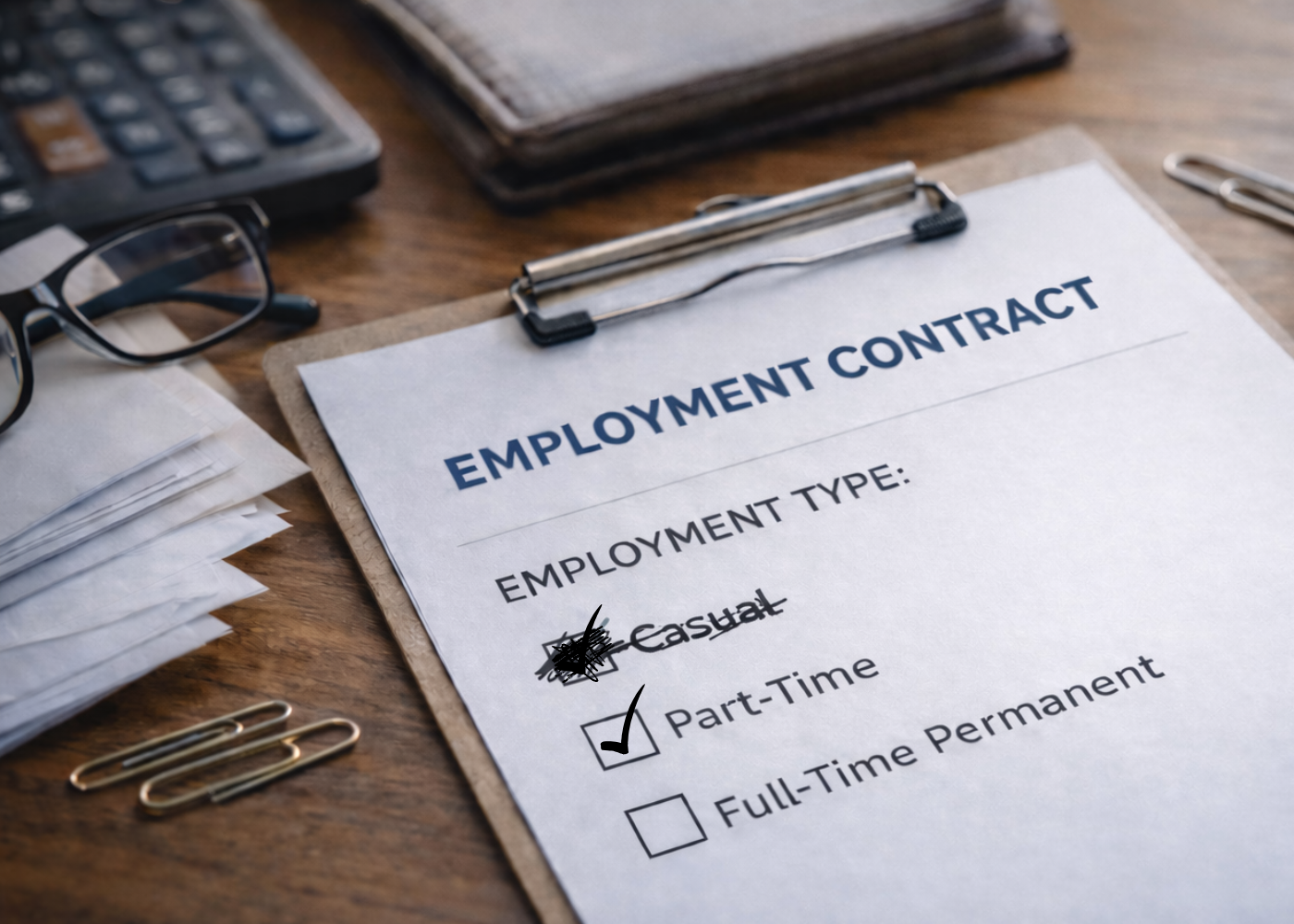
For small business owners and managers, deciding when to employ, who to employ, and on what type of contract is one of the most important strategic decisions you will make.
It’s also one of the most common areas where we see well-intentioned employers inadvertently increase their risk — often without realising it.
One of the biggest traps? The “accidental employee.”
Why casual employment can feel appealing
When a business is new, growing, or facing uncertainty in workflow, committing to guaranteed hours can feel daunting. Permanent or fixed-term employment — whether full-time or part-time — requires you to specify minimum hours and make an ongoing financial commitment, even when future work isn’t guaranteed.
In that context, a casual contract can seem like a safe and flexible option. On paper, it appears to offer the benefits of having someone on hand without the perceived risk of long-term obligation.
But this is where caution is required.
What a casual contract really means
True casual employment is based on no guarantee of work. Each shift or engagement is separate, and either party can say no. Casual employees:
Are not guaranteed hours
Are generally paid 8% holiday pay with their wages
Are not entitled to paid public holidays when the business is closed
If they do work a public holiday, are paid time and a half but do not receive an alternative day off
So far, so good — provided the arrangement remains genuinely casual.
Where employers often get caught out
Problems arise when casual employment starts to look and feel permanent.
If you regularly roster the same person on the same days or times, over a sustained period, a pattern of work can be established. Even if the contract says “casual,” the Employment Relations Authority will look at the reality of the working arrangement, not just the label and here’s the kicker, legislation doesn’t define this, case law does and there’s no clear formula, so you are at the mercy of the interpretation favoured by the ERA member who looks at your case.
Once a pattern exists, the employee may be found to be permanent for those hours, regardless of what the contract says.
Why this matters
If an employee is deemed permanent, this can have significant implications, including:
Guaranteed hours becoming contractually enforceable
Annual leave needing to be recalculated (rather than paid at 8%)
Public holiday entitlements applying if it would otherwise be a working day
Any reduction in hours requiring agreement or a formal restructuring process
In short, what felt like a low-risk option can quickly become a compliance and cost issue — often at the worst possible time.
Is casual employment ever appropriate?
Absolutely. Casual contracts can be the right fit where work is:
Genuinely irregular or unpredictable
Event-based
The key is that the working reality must match the contract.
If a casual contract is being used primarily as a safety net “just in case things slow down,” it’s time to pause and reassess.
A more strategic approach
Rather than defaulting to casual employment, it is often safer — and more effective — to think strategically about what your business actually needs right now.
There are ways to structure:
Part-time permanent roles with clearly defined hours
Fixed-term agreements that meet genuine business needs
Flexible arrangements that balance certainty with adaptability
When done properly, this provides clarity for both parties, reduces risk, and avoids unintentionally creating an implied employment relationship on terms you didn’t choose.
How we help
At EASI NZ, we work alongside small and growing businesses to design employment arrangements that align with their operational realities, growth plans, and risk profile — while ensuring legal compliance and clear expectations.
If you’re unsure whether you may have an accidental employee, or you’d like confidence that your employment structure truly supports your business, now is the time to review it.
A proactive conversation today can prevent a very costly issue tomorrow.